
Out on the line, juice runs hot—87°C to 92°C—and the preform has to land in a tight thermal window before stretch blow molding. If the heater can’t keep up, you end up chasing short shots, PET stress cracks, and wall thickness that’s off. If it overshoots, you’re burning material, wasting energy, and watching oven temperatures drift.
What actually matters
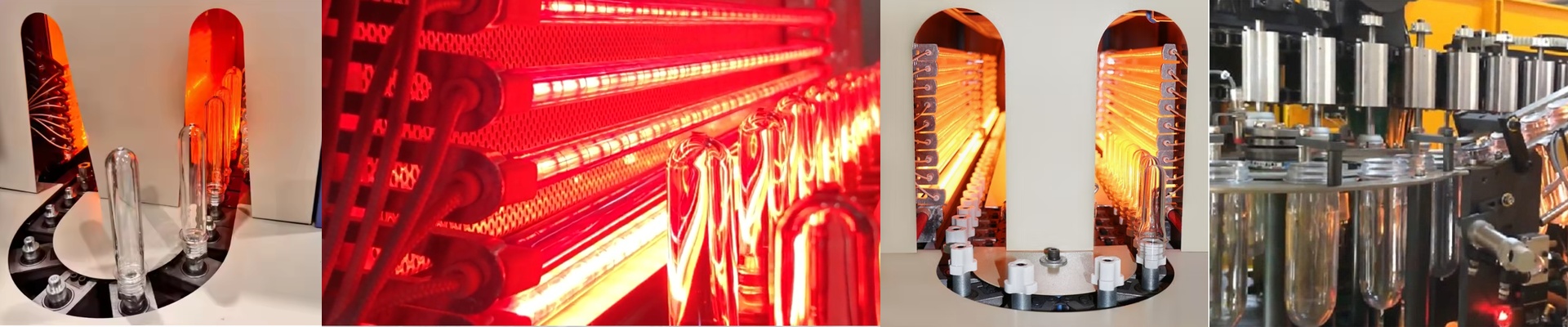
We built the juice bottle hot-fill preform heater around short-wave infrared quartz emitters, because they respond fast and heat the surface precisely. The tunnel envelope, lamp spacing, and reflector geometry are matched to the OEM setup, so heat distribution stays true to the original design. The emitters run on standard voltage, pull predictable power, and use R7s connectors—replacement is straightforward. Each lamp is calibrated for consistent spectral output, so the preform surface heats evenly, without hot spots.
Why it fits this job
With hot-fill juice, the preform has to be uniformly heated to stretch properly and survive thermal shock after filling. This heater puts the thermal profile back where it’s supposed to be, so the blow molder runs at its designed cycle speed without compensating. Plants that switch over report 12–18% lower energy use, because infrared heats the preform directly—less wasted convection heat. Replacements drop, too: the quartz tubes are rated for long service in continuous duty, and we back them with documented mean time between failure data.
What you need to keep straight
It’s plug-and-play only if the lamp length, wattage, and terminal alignment match your blow molder’s heating tunnel. Before swapping, verify the mounting brackets and the condition of the reflectors—mismatched reflectors will give you uneven heating. Keep the tunnel clean and aligned. Dust and misalignment shorten lamp life and widen the temperature spread. If you’re running 24/7, schedule lamp inspections at planned intervals so heating stays repeatable.