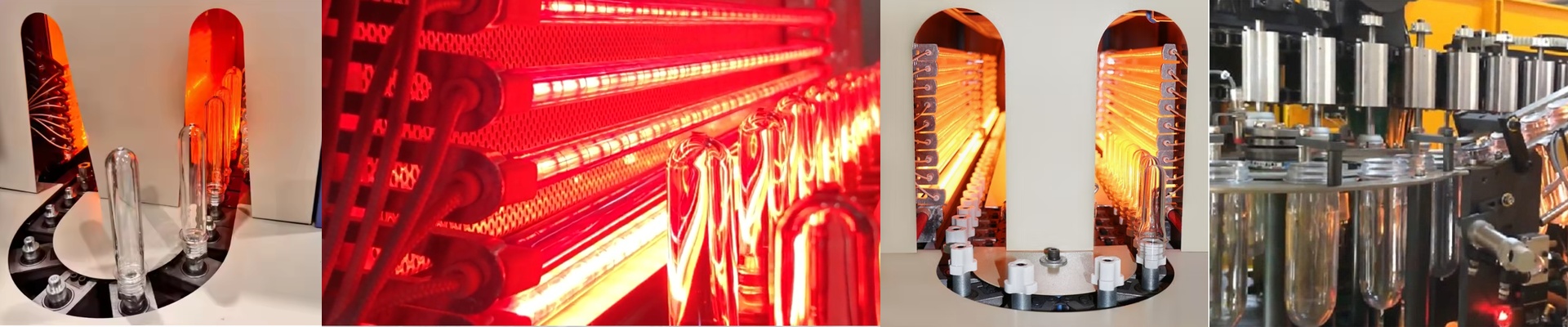
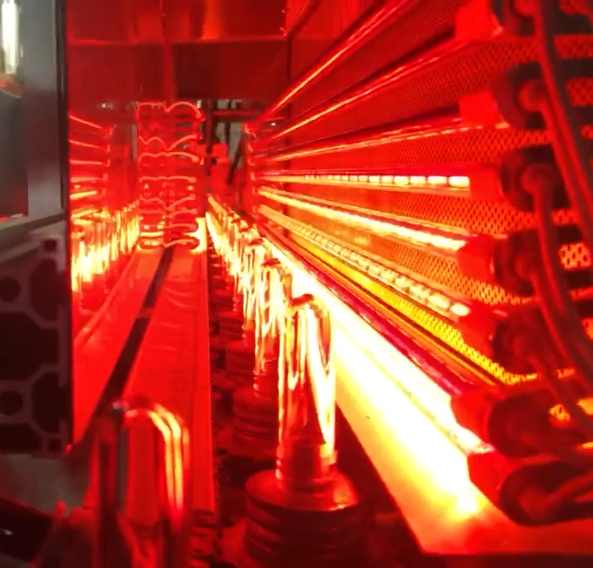
On the plant floor, the heating tunnel doesn’t negotiate. You’re running at line speed, and preforms have to hit the right temperature profile—every single time. When an IR lamp starts drifting, you don’t just lose a bottle. You lose minutes on changeover, you lose stability in stretch ratio, and you lose control of the cycle. We build Krones blow molding machine IR lamps to match the OEM heating-zone requirements, so the lamp drops in as a direct fit and the process stays repeatable.
What actually matters, technically
IR heating in stretch blow molding is not “just a heat source.” It’s a controlled emitter with defined power density, spectral output, and a mechanical interface. If any of that is off, the heating curve moves—and the bottle follows. For Krones blow molders, we align the core parameters that determine compatibility and performance:
- **Emitter type:**Short-wave halogen infrared lamp (quartz envelope) for fast response and predictable heat-up.
- **Power and voltage:**Common Krones heating-zone configurations are supported with 1:1 power ratings—1,000 W, 1,500 W, and 2,000 W options—matched to the machine’s specified voltage (230 V / 400 V, per zone).
- **Length and envelope:**Dimensions stay within OEM envelopes—typically 300 mm, 350 mm, and 400 mm overall lengths, with quartz tube diameters matched to reflector geometry (often 10 mm or 12 mm, per model).
- **Connector and mounting:**Standard Krones lamp interfaces are replicated, including the R7s base and the exact termination style used in the heating module. The lamp seats the same way, aligns the same way, and locks the same way.
- **Spectral and thermal behavior:**Short-wave output is tuned to match preform absorption, so you get rapid, repeatable heating without surface scorching. And if you run a multi-brand plant, the same discipline applies across the major blow molders. Whether you’re on Krones, Sidel, SIPA, Husky, SACMI, or Nissei ASB, lamp specs are aligned to the OEM heating-zone design—voltage, wattage, envelope, and interface—so you can standardize spares without re-engineering the line.
Why this holds up in real running
When the parameters match 1:1, you get uptime and quality you can measure. Preform heating repeatability When lamp output stays on spec, the heating profile stays stable across shifts. That means fewer swings in preform skin temperature, more consistent biaxial stretch, and better control over top load and wall distribution. Changeover speed IR lamps with matched response and mounting get you back to stable heating quickly after a format change. Less time chasing temperature balance equals more liters per hour. Energy use at the zone level Short-wave halogen IR heats the preform directly, not the air around it. With the right wattage and reflector fit, you keep the zone energy where it needs to be—on the preform—so less heat is wasted in the tunnel. Maintenance you can plan around These lamps are built for scheduled replacement, not surprise failure. In typical running conditions, you can plan replacement intervals around 5,000 hours, with output drift held within a tight band (commonly <5% drop over the life window). That turns lamp maintenance into a routine, not a scramble. Cost control—without messing up the process A matched lamp that installs like OEM lowers cost-per-hour while keeping heating zone behavior unchanged. No retuning, no revalidation—swap it in and run.
The details that make or break it
Even with exact parameter matching, real-world performance depends on the rest of the system.
- **Reflector condition drives results.**A lamp can be on spec, but if the reflector is oxidized, cracked, or out of alignment, the heating profile shifts. Replace reflectors when you replace lamps, or expect uneven temperature distribution.
- **Keep the heating zone clean.**Dust and bottle residues absorb IR energy and create hot spots. Clean cooling airflow and clean quartz surfaces matter more than a lot of people think.
- **Match the lamp to the zone, not the label.**Wattage and voltage are not universal. Use the machine’s original zone rating as the reference, not a generic catalog number.
- **Watch power quality.**Voltage fluctuations shorten lamp life. If you’re seeing repeated lamp failures, check for unstable supply, contactor wear, and thermal cycling patterns.
- **Handle with care.**Quartz lamps handle heat well, but they’re brittle mechanically. Use proper handling, avoid touching the envelope, and follow the same E-stop and lockout steps you use for any heater replacement. If you want to standardize IR lamps across Krones, Sidel, SIPA, Husky, SACMI, and Nissei ASB lines without touching the heating logic, start with the exact spec sheet—wattage, voltage, length, connector, and thermal profile—and treat the lamp as the last link in the heating chain. When it matches, the whole zone behaves the way it was designed to.