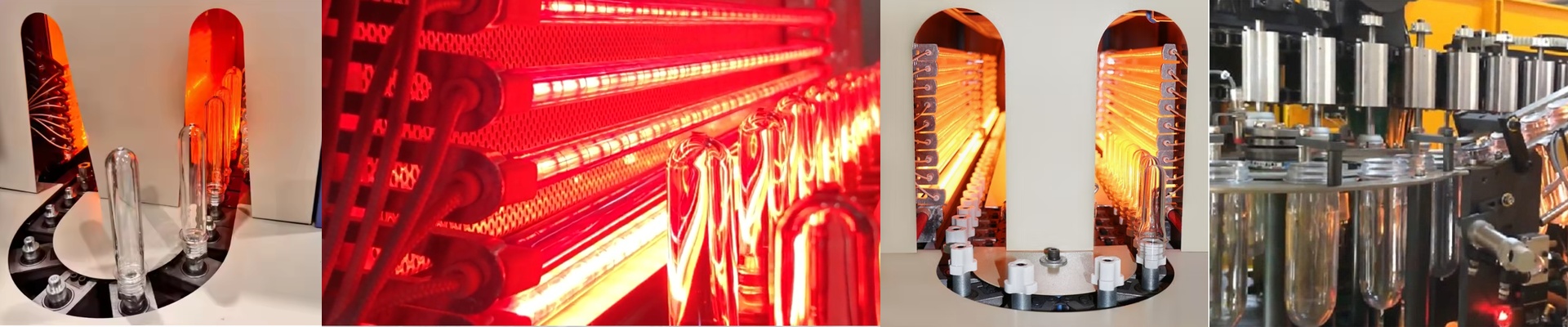
On the line, a blown bottle that doesn’t make the cut isn’t just scrap. It’s downtime, wasted energy, and heat that never translated into bottles. In stretch blow molding, the preform heating profile is where the whole run either sets up or falls apart. If the infrared emitter is lagging, you end up chasing uneven wall thickness, weak necks, and cycle times that drift all day. What matters under the hood We built this single-tube IR lamp as a straight drop-in for bottle blowers, right within the OEM’s thermal and mechanical envelope. The quartz tube is voltage- and wattage-matched, so the short-wave infrared output is consistent—preforms heat fast and even. Precision filament placement and stable resistance keep the heating curve repeatable, run after run, so you’re holding tolerances instead of fighting drift. It uses an R7s connector and standard mounting footprints, so it fits existing clamps and sockets without reworking the heating tunnel. Why it holds up on real machines You get OEM-grade heating performance without the OEM price. We manufacture to the same strict specs, so output consistency and service life line up with the original, but the cost fits a maintenance budget. In practice, that means fewer heating-related rejects, fewer stops to swap lamps, and more stable cycles across Sidel, Krones, SIPA, Husky, SACMI, and Nissei ASB machines. The payoff is simple: less scrap, lower energy per bottle, and more uptime. A few shop-floor details Installation is quick—swap the lamp, set the reflector alignment, and verify the preform path. That said, performance still comes down to clean reflectors and the right spacing. If the tunnel glass is coated or badly oxidized, light transmission drops, and you may need to tweak dwell or power. For the best results, match the lamp wattage to your machine’s original spec and check socket condition before you bring it online.